Showing posts with label Quantum Computing. Show all posts

Thursday, 1 October 2020

Qubits : Heart of a Quantum Computer

Quantum Computing has been creating a lot of buzz for the past few years. Since it was first conceived it has captivated intelligent minds all over the world. Due to its ability to solve problems in minutes, which the current supercomputers will take millennia, these computers promise to solve problems that have haunted researchers and scientists for years.

The last decade has been exceptional for Quantum Computing. Years of research started showing its results and a big breakthrough came last October when Google claimed to achieve Quantum Supremacy.    

But what makes it stand apart from classical computers? It’s the Quantum Bits or Qubits that gives them this incredible processing power. Unlike a classical bit, which can be either 0 or 1 at a time, qubits can also be any combination of 1 and 0 simultaneously. These qubits exploit quantum phenomena like Superposition and Entanglement to provide you the results as fast as possible while you anxiously stare at the computer.       

Qubits are fascinating but their implementation is an arduous task. The information in the qubits is easily destroyed by thermal heats and other disturbances from the environment. This is known as Decoherence.

The colder and more isolated the qubit is, the less likely it is to flip to a different quantum state when it’s not supposed to. But it’s really difficult to keep the qubits cold and isolated.

So with all these challenges, how scientists and researchers are making these bizarre bits possible? Let’s find out.

Superconducting Circuits

This is the most widely used method for making qubits. Companies like IBM and Google rely on this method for their quantum computers. Superconductor materials that have zero resistance when cooled below a certain temperature, like Aluminium and Niobium, are used.

When the temperature drops below a critical value, two electrons form a weak bond and become a Cooper pair that experiences no resistance when traveling through the metal. The pairing opens a gap in the energy state, which any excitation requires some minimum energy. This gap leads to superconductivity since not any random increase in energy is allowed.  


Each qubit is actually an LC circuit, an inductor, and a capacitor. We manipulate its energy state to represent a superposition of |0⟩ and|1⟩.


Now the challenge is to make the energy levels uneven such that the superposition is confined to |0⟩ and |1⟩. To overcome that, the superconducting circuit includes a Josephson Junction.


The junction behaves as a non-linear non-dissipating inductor. It contains two Aluminum superconducting electrodes that are weakly coupled and are separated by a thin insulator about a thousandth of a hair thick. It is non-linear such that the energy level is unevenly separated so we can use two lower states as the bases for our superpositions.


This inductor is combined with a linear capacitor using a Niobium superconductor to create an LC resonator. With correct tuning, the circuit behaves like an atom with two quantum energy levels, i.e. our qubit.

Quantum operations are performed by sending electromagnetic impulses at microwave frequencies (around 4–6 kHz) to the resonator coupled to the qubit. This frequency resonates with the energy separation between the energy levels for |0⟩ and |1⟩. And the duration of the pulse controls the angle of rotation of the qubit state around a particular axis of the Bloch sphere.


To make a measurement, it sends a microwave tone to the resonator and analyzes the signal it reflects back. The amplitude and phase of the reflected signal depend on the qubit state. Once it is amplified, we know the energy level and therefore we can determine the state of the qubit.


To isolate the qubits, the computer contains a dilution refrigerator to cool down the quantum processor to as near as 0 Kelvin.

Silicon Spin Qubits aka “Hot Qubits”

This is a method that many think is the future of quantum computing. Two separate teams of researchers from Australia and Netherlands published a paper in April this year stating that they had performed the 2-qubit operation at 1.5 Kelvin, which is 15 times hotter than rival technologies can withstand.

Each silicon spin qubit consists of a few electrons held within a quantum dot. These quantum dots are tiny wells or divots in silicon that lay just beneath the gate electrode of a conventional transistor. As charge flows through the transistor, electrons drop into the well, and electrostatic forces hold them in place.


To compute with them, the Australian team applied an AC electric field, while the Netherlands team used an AC magnetic field to manipulate the electron spins, causing the spins to point up (1), down (0), or in both directions at once.

With this technique, electrons can be forced to occupy the same quantum dot only if their spins are opposite. If their spins match, the electrons stay put in their respective wells.

After this successful demonstration, Intel has also shifted its focus to hot qubits as these qubits can be made using transistors and Intel ships 400 quadrillion transistors a year.

Trapped Ion Pair

 Another approach to make qubits is through trapping ions and then precisely controlling them using lasers. To trap ions, scientists start with a steel vacuum chamber, housing electrodes on a chip that is chilled to nearly 450 degrees below zero Fahrenheit. 

Ca and Sr atoms stream into the chamber. Multiple lasers knock electrons from the atoms, turning the Ca and Sr atoms into ions. The electrodes generate electric fields that catch the ions and hold them 50 micrometers above the surface of the chip. Other lasers cool the ions, maintaining them in the trap. 

Then, the ions are brought together to form a Ca+/Sr+ crystal. Each type of ion plays a unique role in this partnership. The Sr ion houses the qubit for computation. The Ca ion, which has a similar mass to the Sr ion, takes away extra energy from the Sr ion to keep it cool and help it maintain its quantum properties. Laser pulses then nudge the two ions into entanglement, forming a gate through which the Sr ion can transfer its quantum information to the Ca ion.

To read out this state, the scientists interrogate the Ca ion with a laser at a wavelength that only the Ca ion's electron will interact with, leaving the Sr ion unaffected. 

What's nice about using this helper ion for reading out is that we can use wavelengths that don't impact the computational ions around it; the quantum information stays healthy. So, the helper ion does dual-duty; it removes thermal energy from the Sr ion and has low crosstalk when we want to read out just that one qubit.

Now answer this: Can we manipulate the Nucleus of an atom as a Qubit?? If yes then how?

The race to make a commercial quantum computer continues as researchers and tech giants keep finding ideas to make qubits that can work at an optimal temperature. Until then we will keep tabs on all the quantum computing breakthroughs until one of them finally establishes the quantum age.

References-

1. https://www.qutisgroup.com/wp-content/uploads/2014/10/Amaia_TFG.pdf

2. https://analyticsindiamag.com/how-this-breakthrough-makes-silicon-based-qubit-chips-future-quantum-computing/

3. https://news.mit.edu/2020/trapped-ion-pair-may-help-scale-quantum-computers-0128

Thursday, 9 July 2020

Quantum Phase Battery : A Milestone in the World of Quantum Computing

Hello readers! You might be au fait with the power of quantum computing through our blog  Quantum Supremacy in which we discussed how a Quantum computer beats even the best supercomputers in solving a specific problem.

And recently, the latest advancement as the next step in the world of quantum technology is the discovery of the first-ever quantum phase battery.

Now you might be wondering, how come quantum physics intervene in batteries, right? Let's rewind the basics once again!

Quantum technology works by using the principles of quantum mechanics (the physics of subatomic particles).In quantum technologies, circuits or devices are based on superconducting materials. The quantum phase battery represents an essential element for quantum technologies based on phase coherence.


The term "quantum phase battery" needs basic knowledge of some quantum physics-related terms supercurrents and phase coherence for the principle behind the working of this battery.


How does it work?


Before discussing this great discovery, the more obvious question to be answered is how does it work and what makes it different and better than classical ones.

Batteries have been there to power the circuits and we have been using them from the time it was just a classical battery, a Volta's Pile, the first electrical battery that could continuously provide electric current to the circuit, to the Li-ion batteries most commonly being used in everyday life. 

These batteries convert the chemical energy into a voltage, which can then be used as a power source for the working of electronic circuits.

But what if the current could be made to flow without the need of any applied voltage. Is this possible? In quantum technology, such currents are termed as Supercurrents

The term got the super attribute for the fact that these currents do not exhibit any energy losses and are not dependent anymore on any voltage to be applied. 

They are induced not from a voltage but from a phase difference of the wave function of the quantum circuit, which is directly related to the wave nature of the matter.

A quantum device that could be able to provide and maintain a persistent phase bias to the wave function can be seen as a quantum phase battery, which induces supercurrents in the electronic circuits.

Hence the quantum technology provides such materials that could power the circuits with these Supercurrents therefore there will be no need for those classical batteries anymore.

This is exactly what a team of researchers has claimed to build out of this theory and have proposed the experimental and theoretical results that led to the fabrication of the first quantum phase battery; which consists of Indium Arsenide (InAs) nanowire in contact with aluminum super leads. 

The n-doped InAs nanowire forms the core of the battery (the pile) and Aluminium superconducting leads as poles. The battery is charged by applying an external magnetic field, which then can be switched off.


Sebastian Bergeret from the Mesoscopic physics group at the Materials Physics Center (CFM, CSIC-UPV/EHU), a joint initiative of Consejo Superior de Investigaciones Científicas (CSIC) and the University of the Basque Country (UPV/EHU), and Ilya Tokatly, Ikerbasque Professor in the Nano-Biospectroscopy group of the UPV/EHU, both Donostia International Physics Center (DIPC) associate researchers had devised the idea of such a quantum phase battery in 2015.

They proposed a theoretical system with the properties needed to build the phase battery. Bergeret and Tokatly's idea of such a device consisted of a combination of superconducting and magnetic materials with an effect, called spin-orbit coupling.

Spin-orbit coupling (SOC) can be regarded as a form of effective magnetic field 'seen' by the spin of the electron in the rest frame.SOC is one of the relativistic effects and it occurs whenever a particle with non-zero spin moves around a region with a finite electric field.


A few years later Francesco Giazotto and Elia Strambini from the NEST-CNR Institute, Pisa, identified a suitable material combination and fabricated the first quantum phase battery.


Scientists noted, “…...We find that the ferromagnetic polarization of the unpaired-spin states is efficiently converted into a persistent phase bias φ0 across the wire, leading to the anomalous Josephson effect. 

We apply an external in-plane magnetic field and, thereby, achieve continuous tuning of φ0. Hence, we can charge and discharge the quantum phase battery.

……. Our results demonstrate how the combined action of spin-orbit coupling and exchange interaction induces a strong coupling between charge, spin, and superconducting phase, able to break the phase rigidity of the system.”

Cristina Sanz-Fernández and Claudio Guarcello also from CFM adapted the theory to simulate the experimental findings.

This battery is further being improved at CFM premises in a collaboration between the Nanophysics Lab and the Mesoscopic Physics Group. 

Some researchers have proposed a new idea that these quantum batteries could use qubits built either from superconductors or from semiconducting quantum dots.  

"Any sufficiently advanced technology is indistinguishable from magic".Quantum technologies have been turning this aspect around -what if we use quantum physics to build quantum devices.

This device like other quantum devices contributes to the advancements made in the quantum technology world and it is now expected to see quantum technology revolutionize more and more in the near future.

This was all about the latest advancement in Quantum Computing and we hope you found it informative and interesting. Do like and share this blog with all your tech geeks and your suggestions in the comments will be highly appreciated!

Thursday, 2 January 2020

Quantum Supremacy

On the 23rd of Oct, I was scrolling down Google Chrome’s home page for some interesting news. In the midst of which politician backstabbed which party and government denying economic slowdown, I saw something that instantly grabbed my attention. 

The news quoted, “Google has claimed to achieve Quantum Supremacy!”. 

Now, what the hell is “Quantum Supremacy” and how Google achieved it? Let's find out.

Quantum Supremacy is when a Quantum Computer beats the best Supercomputer in solving some kind of problem. Before getting into it we need to first understand how quantum computers work and how they are different from the computers we have.

For doing this we have to discuss two phenomena of quantum physics- “Superposition” and “Entanglement” which gives quantum computers an edge over the classical computers.

Superposition states that a quantum system can be in different states at the exact same time untill it is unobserved. Now we know that classical computers work on bits which are either 0 or 1.

Quantum Computers work on qubits (quantum bits) which are in a superposition of probabilities for 0 and 1 (like it can be 0 or 1 or an intermediate state), and you can’t predict which one will it be. But the instant you measure it, it collapses into one of its state. This is what gives that incredible processing power to the quantum computer.

For example- 2 bits can be in one of the 4 different configurations (00, 01, 10, 11) at one time. 2 qubits can be in all the four configurations at the same time storing more information than bits.

Entanglement is a close connection that makes each of the qubits react to a change in the other’s state instantaneously, no matter how far they are. This means by measuring just one entangled qubit, you can directly deduce properties of its partners without having to look. This property is so weird that the great scientist Albert Einstein called it “Spooky action at a distance”.

In classical computers there are logic gates, which takes a set of inputs and produce a definite output while in Quantum computers there are Quantum Gates, which takes an input of superpositions and produces another superposition as its output and measures the outcome, collapsing superpositions to an actual sequence of 0s and 1s.

It means that you get all the calculations that are possible with your input at the same time. Ultimately you can only measure one of the results and it will probably be the one you want.

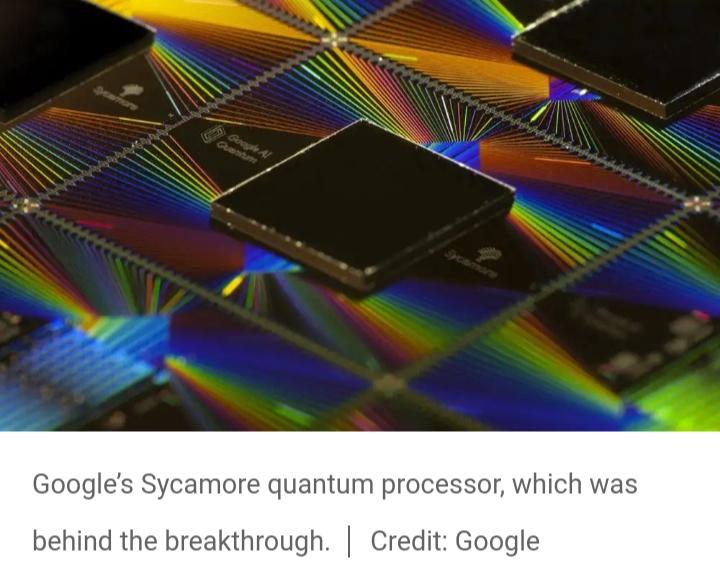
Now coming back to Quantum Supremacy, Google has claimed to achieve it with its quantum computer having a 53 qubit Sycamore Processor by beating IBM’s supercomputer in solving a complex circuit.

           
While the race for the first commercially viable quantum computer continues, Quantum Computers can definitely revolutionise our world we see today.